



















Personal branding sites are very different from normal business websites, yet most people treat them exactly the same.
That is where things start to go wrong.
A traditional website is usually built like a brochure.
It shows services, explains what a company does and provides a few pages about the team behind it.
A personal branding site has a completely different purpose.
It exists to showcase the person behind the expertise.
It positions them as the authority, highlights their appearances and achievements, and gives people a clear reason to book them.
Done properly, it becomes a hub for credibility, authority and opportunity.
Done poorly, it becomes nothing more than an online CV.
In this article we will break down what personal branding sites actually are and what most people get wrong.
We will also look at the key elements that help your site build authority and open doors.
What Are Personal Branding Sites?
A personal branding site is a website designed to showcase an individual and their expertise rather than a company or a specific service.
The goal may still be the same as a traditional website…
You might want to generate leads, book calls or grow an email list.
The difference is in how the site is structured and what it focuses on.
Instead of highlighting products or services first, the focus is on the individual.
Personal branding sites often feature things like:
- Podcast appearances
- Media coverage
- Speaking events
- TV features
- Books or publications
- Personal story and background
- Authority proof and social proof
The aim is not just to sell a service.
The aim is to clearly position you as an expert and show exactly why someone would want to book you, invite you to speak or feature you in their content.
It becomes a platform that answers three important questions very quickly.
Who are you?
What do you specialise in?
Why should someone book you?
What Most People Get Wrong With Personal Branding Sites
After building and reviewing many websites for entrepreneurs and experts, the same problems appear again and again.
The first mistake is making the site entirely about themselves.
This might sound strange for a personal brand site, but the reality is that people visiting your website are asking one question.
What is in this for me?
Your site should make it clear how your expertise benefits the audience.
What insight do you bring.
What perspective can you offer that others cannot.
The second mistake is turning the site into an online CV.
A list of achievements might look impressive but it does very little to guide someone toward taking action.
Your site should show your authority but it should also move people towards a next step.
Another common issue is vague positioning.
If someone lands on your website and cannot quickly understand what you specialise in, they will leave.
Strong personal brands are known for something specific.
Clarity builds authority.
And finally, many personal branding sites fail to capture personality.
People want to see how you speak, how you present yourself and how you think.
Your website should feel like an extension of you, not a generic template with your name inserted.
Who Should Have a Personal Branding Site?
You do NOT need millions of followers to have a personal brand website.
What you NEED is expertise and consistency.
If you regularly show up online, share ideas, appear on podcasts or speak at events, you already have the ingredients for a strong personal brand site.
At the time of writing this, I (Nicole) have around 1600 followers on Instagram. That might not sound like a huge audience…
But you do not need a huge audience if you have built the right one…
I have been a guest on multiple podcasts, spoken at events and host our own podcast, Breaking the Brand.
People are interested in hearing what you have to say when you specialise in something and consistently show up.
And an additional tip:
Every time I speak somewhere, we film it.
Every podcast appearance gets recorded.
Every talk becomes content that can be used as proof of expertise.
You do not need a massive following.
You need proof that you know your subject and that people want to hear your perspective.
When you specialise in something and consistently share your insight, people start looking for your opinion.
That is when a personal branding site becomes incredibly powerful.
The Key Elements Every Personal Branding Site Needs
A strong personal branding site should answer three questions immediately.
Who are you?
What do you specialise in?
Why should someone book you?
To answer those questions properly, the site needs several core sections.
A clear biography explaining your background and experience.
Authority proof showing where you have been featured, including podcasts, publications, interviews and speaking appearances.
A personal story that helps people understand your journey and what drives your work.
Social proof such as testimonials, media mentions or collaborations.
And finally, a clear call to action explaining what someone should do next.
Whether that next step is booking you for a talk, inviting you onto a podcast or enquiring about collaboration, it should be obvious.
If someone has to search for the next step, the site is not doing its job.
Case Study: Lewis Crompton’s Personal Branding Website
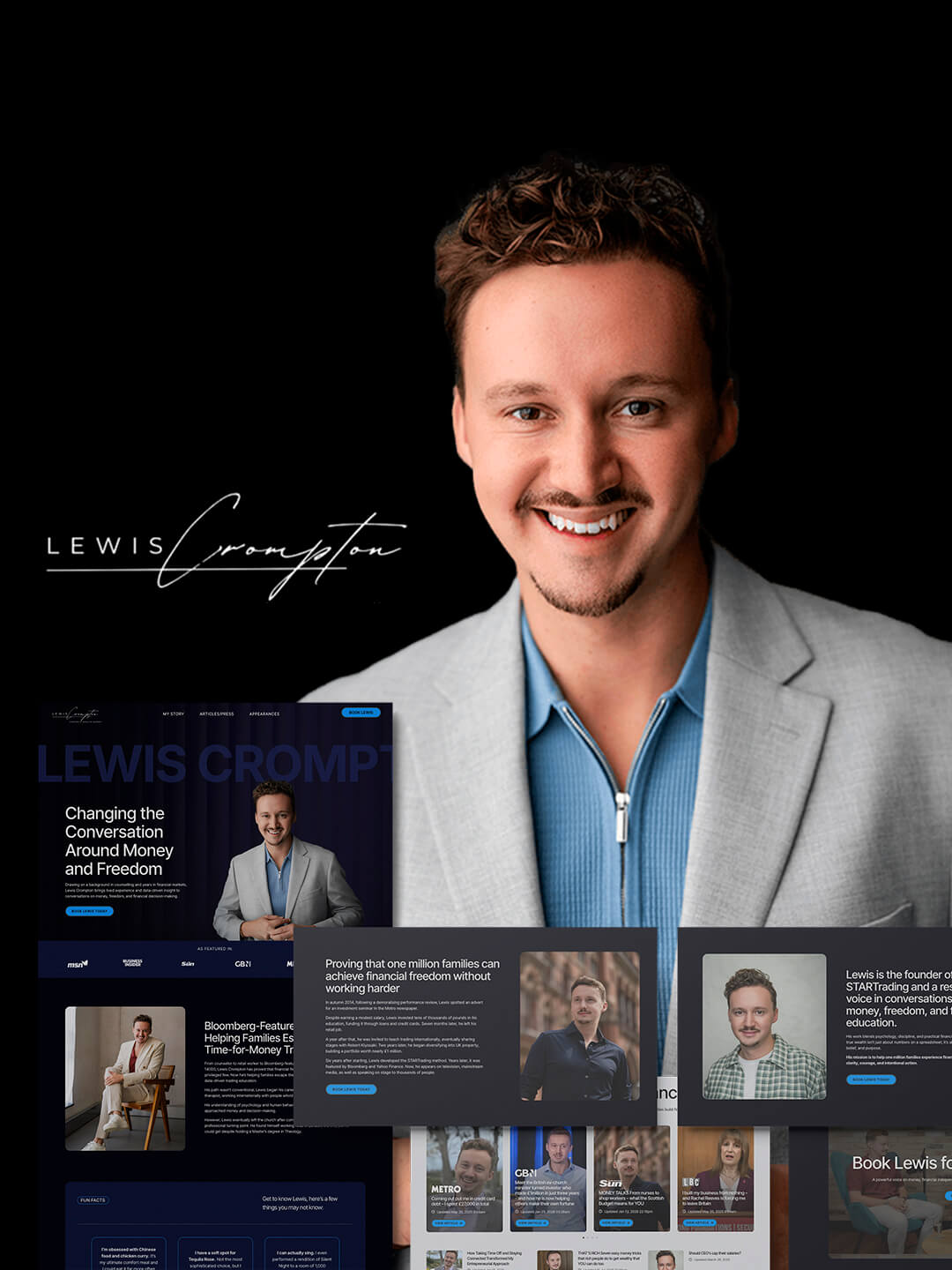
One of the most recent personal branding sites we built was for Lewis Crompton, a trader and financial investing expert.
Lewis has a strong background in finance and wealth investing, but the goal was not just to present information. The goal was to build authority and create a place where people could instantly see his credibility.
We focused heavily on injecting personality and professionalism into the site.
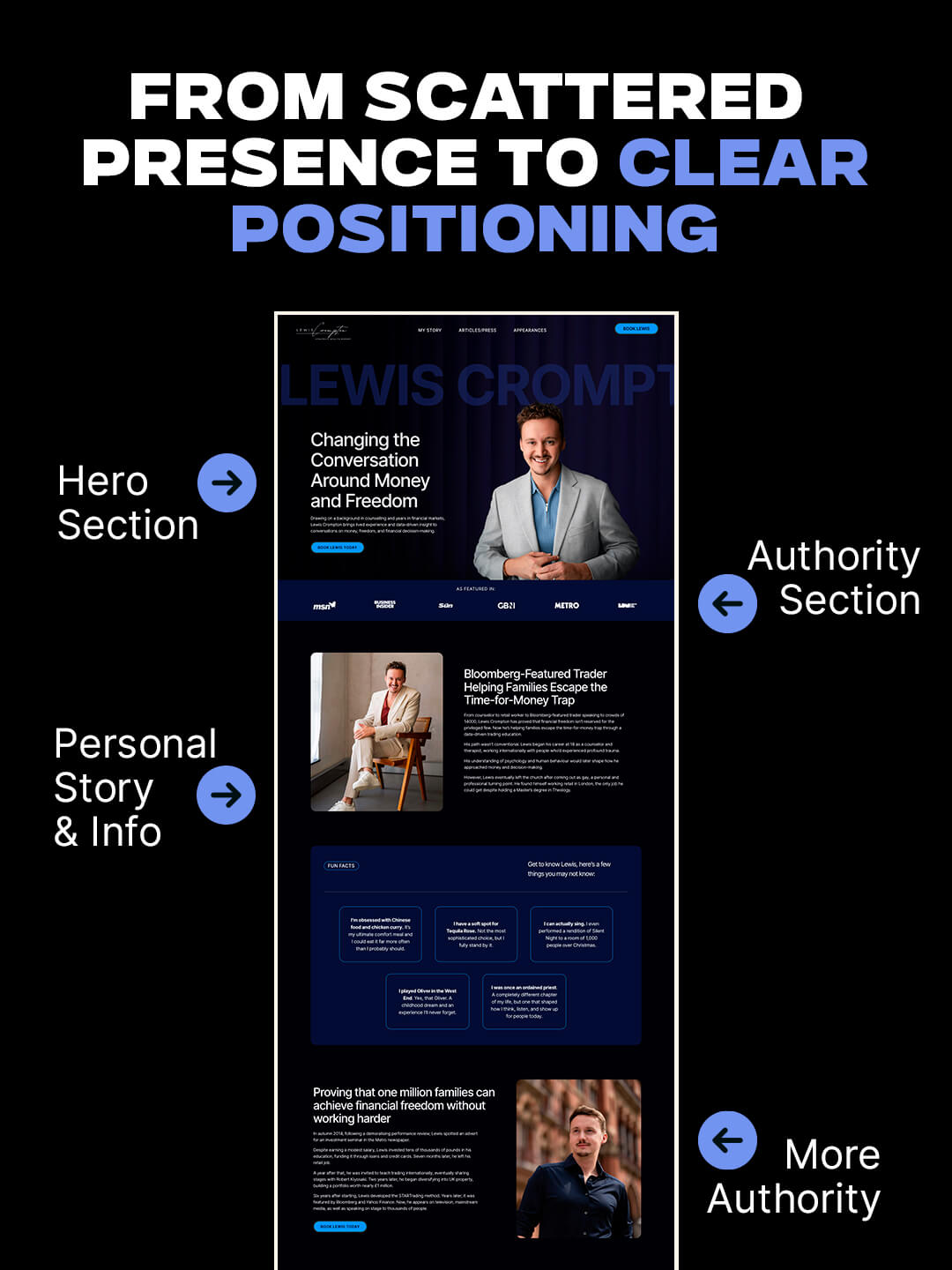
Sections highlight Lewis’s background, his journey and the things that shaped his expertise.
We also included smaller details such as personal facts and interests to make the site feel human and relatable.
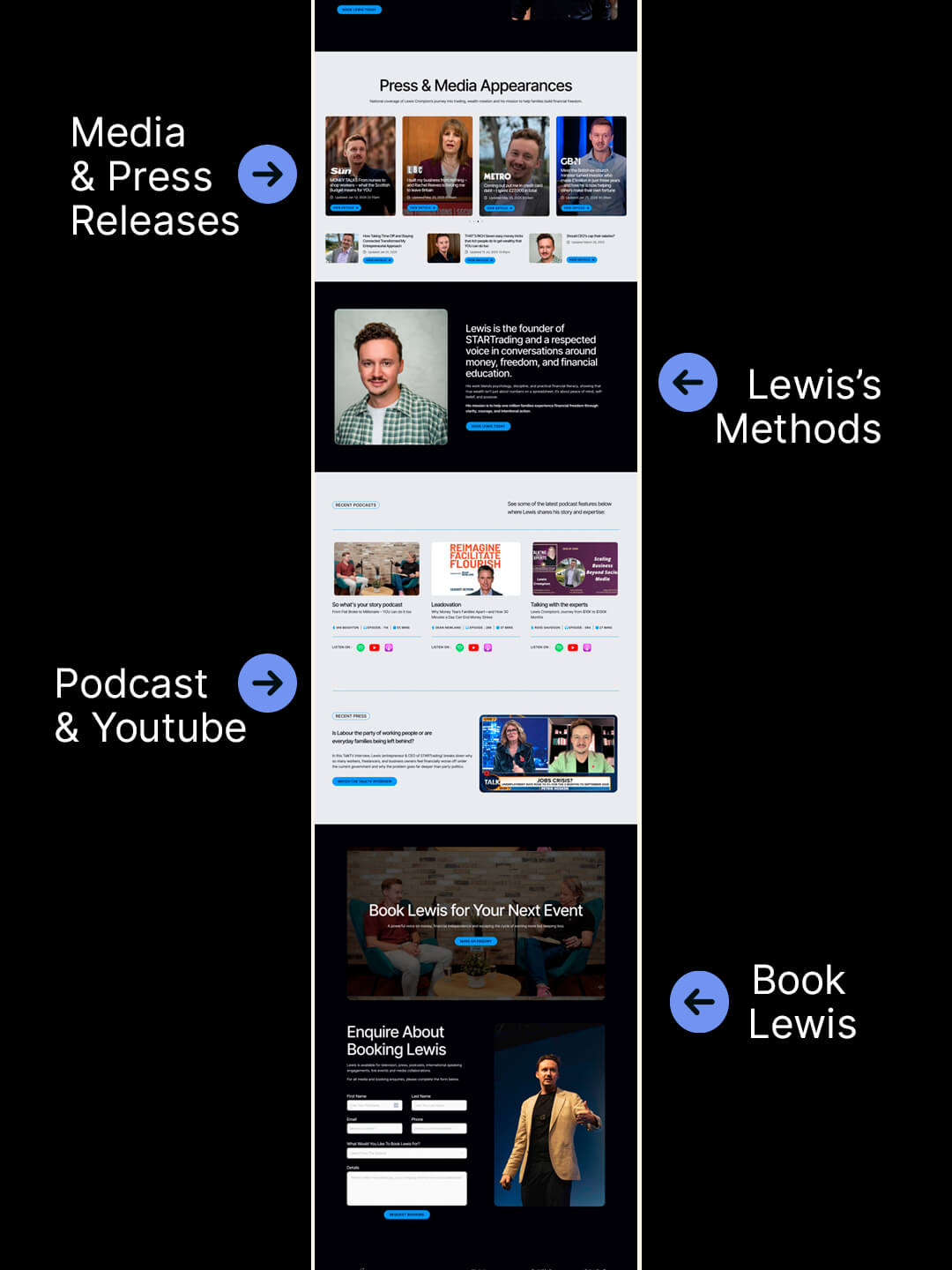
Authority proof also plays a major role throughout the site. Lewis has appeared in multiple publications, articles, television segments and podcasts. Instead of simply listing these appearances, we linked directly to each feature so visitors can see the proof themselves.
This builds instant credibility.
The site also leads visitors toward a clear enquiry form where they can specify what they would like to book Lewis for. That might be an event appearance, a speaking opportunity or a media feature.
Lewis has even used the site at red carpet events…
Instead of handing someone a business card, he can simply share a link to his personal brand page.
Within minutes someone can see his authority, watch appearances and understand exactly what he brings to the table.
It feels far more professional and allows people to build trust before they even reach out.
You can see the site here: https://lewiscrompton.co.uk/
Great Examples of Personal Branding Sites
Not only did I want to share an example of a personal branding site we have built recently, but it is also useful to look at what already exists and who you can take inspiration from.
Here are five well known entrepreneurs who have built excellent personal branding websites that clearly showcase their authority:
Tony Robbins
https://www.tonyrobbins.com/
Steven Bartlett
https://stevenbartlett.com/
Marie Forleo
https://www.marieforleo.com/
Ramit Sethi
https://www.iwillteachyoutoberich.com/
Sara Davies
https://sara-davies.com/
Each of these sites makes it immediately obvious who the person is, what they specialise in and where they have appeared.
They also give visitors multiple ways to engage, from content and podcasts to speaking and media opportunities.
Why Design Matters for Personal Branding Sites
Don’t get me wrong, structure and content are critical, but design plays an equally important role.
If a personal branding site looks rushed or poorly put together, it sends a message whether you intend it or not.
It suggests a lack of care.
People subconsciously judge credibility through presentation.
If someone positions themselves as an expert but their website feels messy or outdated, that disconnect weakens trust.
A well designed site communicates the opposite.
It shows attention to detail. It shows professionalism. It shows that you care about how you present yourself.
When a site is beautifully designed, easy to navigate and works seamlessly across devices, it reinforces the idea that the person behind it takes pride in what they do.
And perception matters.
What Outcomes Should a Personal Branding Site Deliver?
The outcome of your personal branding site depends entirely on what you want to achieve.
Some people want more speaking opportunities.
Others want podcast appearances, media coverage or in person event bookings.
Some want to build an email list and grow an audience.
The structure of the site should support that outcome.
In Lewis Crompton’s case, we created specific enquiry options so visitors can clearly indicate what they want to book him for. This makes the process much more focused than a generic contact form.
The key is to think carefully about the next step you want someone to take and design the site around that journey.
Thinking About Creating Your Own Personal Branding Site?
If you are building a personal brand or trying to position yourself as an authority in your field, your website should be doing a lot more than acting as a digital business card.
It should clearly communicate who you are, what you specialise in and why someone should choose you.
If you are not sure how to structure your site, map out your customer journey or present your authority in the right way, we can help.
At Digital Bear Studio we offer a free brand audit where we review your current brand, your positioning and your website strategy.
Whether you decide to work with us or not, you will receive honest feedback on how to strengthen your brand and create a clearer path toward the opportunities you want to attract.
If you would like help mapping out your personal branding site or refining your customer journey, you can book your free brand audit below.

Written by: